
Astrofest 2026
November 5 – 11, 2026.
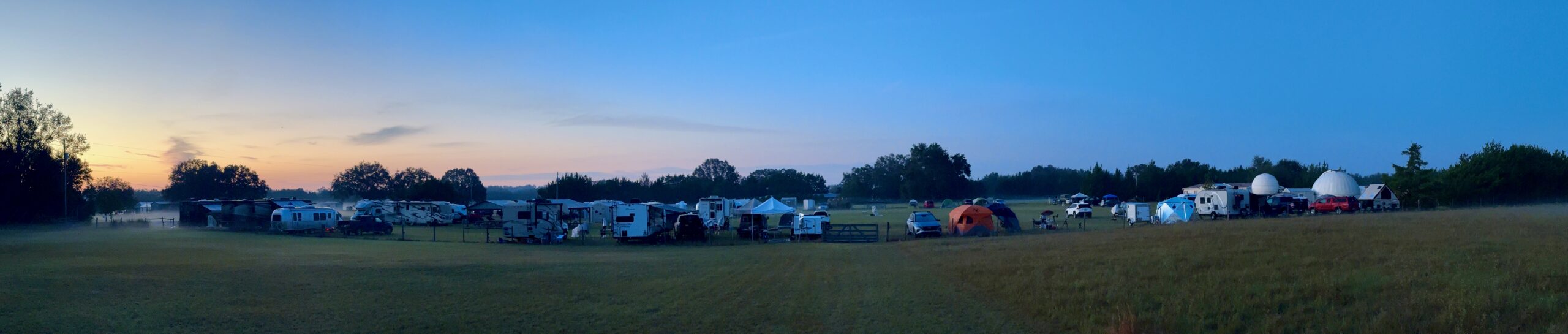
Welcome to the Chiefland Astrofest at one of the best observing sites in the country, the Billy Dodd Memorial Field in the Chiefland Astronomy Village. If you have never attended a Chiefland Star Party, get ready for some of the finest observing and imaging in the USA. If you are a regular visitor to our place, welcome back. The Chiefland Astronomy Village’s great weather, dark skies, on-site facilities, and the line-up of great speakers all add to the unique Chiefland experience.
On top of that, Chiefland Astronomy Village has the distinction of being virtually insect free. Nights in October are generally clear and cool, with temperatures at night of 55˚ – 65˚ F and 70˚ – 80˚ F during the day.
The Chiefland Astronomy Village is located near the west coast of Florida, one hour west of Gainesville and two hours northwest of Orlando. It enjoys moderate temperatures and plenty of comfort. The observing field boasts a beautiful array of amenities. First and foremost, it is dark. The private five-acre field features showers, a clubhouse, restrooms, a picnic area, electricity, and more. The ground is flat, providing easy setup of equipment, tents, and RVs. It also offers 360 degrees of unblocked horizon.
Registration
Registration is now open at https://chieflandastro.regfox.com/astrofest-2026-regular. Please register soon to ensure you have the kind of site that works for you. Last year, we sold out of all RV by August. Also, please note that early registration will end on September 30, 2026. Late registration fees are 20% higher.
Food Vendor
We are finalizing details with a new local food vendor for some great meal and snack options. Stay tuned for more information!
Star Party Shirts
Astrofest 2026 shirts and more are on sale NOW. Orders placed before October 12th are set to ship to the event for pickup at registration. Visit the store here: https://www.bonfire.com/store/chiefland-astro/
Schedule
Sunset is around 6:40 pm, astronomical dusk ends at 8 pm, and twilight starts at 6:30 am.
Thursday, November 5, 2026: Arrival Day, arrive before sunset at 6:54
- Registration from noon to 6 pm
- Noon: The field opens early for RV arrivals
- 2:00 pm: The field opens for all arrivals
Friday, November 6, 2026
- 3:00 pm – 3:50 pm, Presentation
Cliff Gosney, DIY Equatorial Platform - 4:00 pm – 4:50 pm, Presentation
TBA
Saturday, November 7, 2026
- 10:00 am – 2:00 pm, First Swap Meeting
- 3:00 pm – 3:50 pm, Keynote Presentation:
Dr. Adam Ginsburg, University of Florida, “The Galactic Center” - 4:00 pm – 4:30 pm, Presentation
Dr. Jerry Cheney, “Regulus Lunar Occultation” - 4:45 pm – 5:00 pm
Dr. Richard G. Hennig, Chiefland Astronomy Heritage Museum
“Project Alvan – Update on Restoring the Vision of 1885.”
Sunday, November 8, 2026
- Raffle prizes will be set-up in the pavilion on Sunday afternoon. Prize viewing and ticket deposit into the prize bins will be available afterwards.
- Raffle of Donated Prizes 1:00pm
- Dinner of burgers, brats, potato salad provided 5:00 – 6:00.
Monday, November 9, 2026
- 10:00 am – 2:00 pm, Second Swap Meeting
- 3:00 – 3:50 pm, Presentation
Charlie Warren “31-Years of Amateur Astronomy” - 4:00 – 4:50 pm, Presentation
TBA
Tuesday, November 10, 2026
- Explore some of the Nature Coast Attractions with friends or on your own
Wednesday, November 11, 2026
- Departure by noon
- If you plan to stay longer, make sure you have signed the waiver and paid the donation to support the Billy Dodd Observing Field.
Speakers

Keynote Speaker
Dr. Adam Ginsburg, University of Florida “The Galactic Center”
Abstract: The center of our Galaxy is full of stars, gas, and active, energetic events. It has long been hidden from our view in the optical, but radio and infrared telescopes have opened the inner Galaxy for exploration. I will give a tour of the innermost regions in the Milky Way, from the inner ends of the spiral arms along the bar into the central ring of gas. There is weird and intriguing molecular chemistry, explosive star formation, and the full life cycle of hundreds of millions of stars all within a few degrees on the sky. Each of these aspects of Galactic space shows different and beautiful features that I will show in images as I tell the story of how gas moves inward in our Galaxy.
About the Speaker: Dr. Ginsburg began his career as an undergraduate at Rice University, earning a B.S. in Astrophysics, in 2007. He went on to earn his PhD in Astrophysics at the University of Colorado in 2013. He was a European Southern Observatory (ESO) fellow in Garching, Germany from 2013 to 2016 then was a Jansky fellow at the National Radio Astronomy Observatory (NRAO) in Socorro, New Mexico from 2016 to 2019 before coming to the University of Florida.
Dr. Ginsburg studies the formation of the most massive stars and how their formation process affects their neighbors, with the aim of understanding what physical processes control the stellar initial mass function. He uses primarily radio and millimeter telescopes to measure the molecular interstellar medium, which is the gas phase from which stars form. Turbulence and chemistry are the two most important and least understood processes that affect both how the stars form and how we detect their birth environments, so his research includes these fields by necessity. He is also interested in the maintenance and development of new tools to facilitate observational astronomy and comparison between simulations and observations.
His areas of expertise include High-mass Star Formation, Radio and Millimeter Astronomy, Molecular Interstellar Medium (ISM), Turbulence in the ISM, Astrochemistry and Astronomical Software Development.

Speaker
Dr. Jerry Cheney. “Regulus Lunar Occultation”
Abstract: Lunar eclipses are common events in the night sky. Understanding the geometry and physics of these events allows us to understand and predict the images we see. We’ll discuss how to obtain and understand the images we collect during lunar eclipses.
About the Speaker: Jerry Cheney grew up in southeast Texas. He earned his BS in Biology from Lamar University in 1976 and went on to earn his PhD in Biological Oceanography from the MIT/Woods Hole Oceanographic Institution Joint Program in Oceanography in 1981. He then accepted a Postdoctoral Fellowship at Dalhousie University in Halifax, Nova Scotia, where he met and married his lovely wife, Marianne. They have two sons, Michael, an industrial engineer in Tampa, and Chris, currently in his final year of Pharmacy School at UF.
Dr. Cheney taught oceanography at the college level and continued his studies of the distribution of zooplankton in the North Atlantic, but after ten years he decided to change careers to become an optometrist. He graduated from the New England College of Optometry in 1994. The family moved to Florida in 1997 and eventually settled in Ocala, where Dr. Cheney practiced for fifteen years. He had the good fortune to be able to retire in 2014.
Dr. Cheney always had an interest in astronomy, and being a scientist by general nature and training, he has taken up astronomy as hobby in retirement He joined the Alachua Astronomy Club in 2015 and has served in the club’s administration for many years, including as president from 2017 to 2019. He teaches science courses, including astronomy, through Senior Learners in Ocala.
.
SPONSORS & RAFFLE PRIZESIf you are a vendor and interested in sponsoring Astrofest, please email us at chieflandastro@gmail.com.





Raffle Prizes from our Sponsors
If you are interested in sponsoring Astrofest 2025 and providing a raffle prize, please contact us at chieflandastro@gmail.com.
Click here to read about Astrofest 2024, Astrofest 2025 and see some of the pictures in our Gallery.